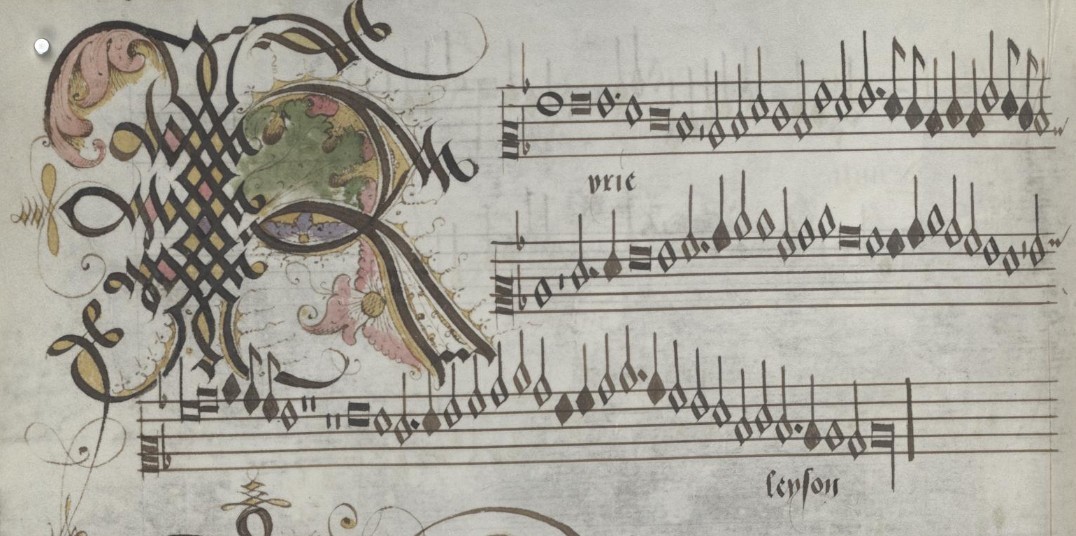
Much of Agricola's finest music sounds quite different to that of his more famous contemporaries Josquin dez Prez and Pierre de la Rue, and the main reason for this is Agricola's adventurous deployment of complex rhythmic structures in his part-writing. Some of Agricola's music is so rhythmically complicated that many modern scholars have concluded - without a great deal of hard evidence - that such works, when secular, must have been intended for instrumental performance. Whether or not that is the case I do not intend to address here, but readers interested in this topic should look up Warwick Edwards' fine article on the subject entitled Agricola’s Songs Without Words. The Sources and the Performing Traditions, which is readily available online. What is beyond doubt, however, is the fact that some of the music that survives in Agricola's greatest Mass settings is every bit as demanding and "instrumental" as anything he wrote for exclusively secular use, many such works of which are now routinely described as "instrumental". One of the aims of this online edition is to make as many of these works as possible available for purely vocal performance, if desired, especially where viable texts are indeed available in cases where the direct source materials fail to provide them. Only then can informed judgements be made.
Just as Agricola is more adventurous than any of his contemporaries in terms of rhythm, I believe the evidence suggests he was also more adventurous in terms of harmony, especially when it comes to issues associated with both hexachordal selection and chromatic alteration. These two aspects of composition must be understood not only technically, but - perhaps even more importantly - in terms of the wider ramifications of a particular aesthetic framework under which music operated around the turn of the 16th century, the mechanics of which is widely - and pretty much consistently - described by music-theorists spanning the entirety of this period. For a fuller understanding of what this musical aesthetic entailed, please read the article linked immediately below, which is an updated version of part of my 1999 thesis presented in partial fulfillment of the requirements of the "Doctor of Music" degree received from the University of Alberta, Edmonton, Canada, in 1999.
Perhaps even more than most composers from this period, the authenticity of many works attributed to Agricola in various sources dating from around 1500 - especially shorter secular pieces - is very much open to question. My plan at this early stage of the process of compiling and presenting this edition is to include as many of these conflictingly attributed pieces as possible without further comment. If, as work progresses on the edition, aspects of style, in particular, arise that might point in one way or the other in this regard, I will be sure to note these.
EXCERPT FROM WILLIAM KEMPSTER THESIS FOR THE DEGREE OF "DOCTOR OF MUSIC"
UNIVERSITY OF ALBERTA, CANADA, 1999
TO FIND SCORES, PLEASE CLICK ON ONE OF THE THREE OPTIONS AT THE TOP OF THE PAGE:
SACRED MUSIC, SECULAR MUSIC or INSECURE.
PRICING AND DELIVERY INFORMATION CAN BE FOUND UNDER THE ORDER LINK, ALSO AT THE TOP OF THE PAGE
Numerous scholarly aricles will result from the work that has gone into compiling this edition,
and links to these will be placed here, as well as within my "Beyond the Score" website (see below)
Alexander Agricola’s Fors seulement in Petrucci’s Harmonice Musices Odhecaton,Canti C: A new edition and a re-evaluation
Hexachords, sequences, and aesthetic beauty in the Sanctus of Agricola’s Missa secondi toni: A case study in editorial practice
This paper is formatted as an interactive PDF with audio. Unfortunately, however, the audio examples will only play via Acrobat or Foxit readers.
Check out my related websites:
Pierre de la Rue: A 'Complete' Performing Editionechoraleditions - over 200 free scores and recordingsBeyond the Score - a Classical Music Magazine and Occasional Blog