Insecure/conflicting attributions
For a significant quantity of music from this period, the true identity of the composer of certain specific works is sometimes difficult to authoritatively establish. In this edition I will try to included all pieces that have been flagged as having a potential association with Agricola on the Digital Image Archive of Medieval Music (DIAMM) website, which is about as broadly applicable a reference as currently exists. The current site has no affiliation with DIAMM, and makes no claim about any of this repertoire that is attributable to DIAMM, other than to acknowledge that their website remains an invaluable resource for anyone interested in this music
A solis ortis cardine * (8 pages)
* Attributed to Alexander in D-B MS Mus. 40021, but he didn't write it. See the detailed note on page 1.
Page 1Complete MP3 RecordingAdieu fillette de regnon * (Realised as a Rondeau - 15 pages)
* No strong attribution to Agricola. Attributed to Isaac by some, but that attribution in Canti B seems without justification. Complex off-set simultaneous sequence use very consistent with Agricola. See notes on page 1.
Page 1Complete MP3 RecordingArce sedet Bacchus * (2 pages)
* This work is a partial contrafact of Firminus Caron's "Le despourveu infortune", which is set for three voices. In the present piece, only the top line of is borrowed, and the bass line seems to be an original addition, possibly not even by Agricola, but Erasmus Rotenbucher, the author of the volume of contrafact duos in which this appears.
Full scoreComplete MP3 RecordingDulces exuvie (exuviae) dum fata Deusque *
* Before I started this edition I thought this piece was more likely Agricola than la Rue. Having looked at all of Agricola's works, however, I now find it more likely that la Rue wrote this rather than Agricola. The canonic imitation that exists here seems more la Rue-like than Agricola, but maybe this might even be Josquin?
Page 1Complete MP3 RecordingEn effet se ne reprenez * (Rondeau - 10 pages)
* No strong attribution to Agricola, but Clemens Goldberg suggests it could be.
The piece is strong, so the composer is likely a major figure, and could possibly be Agricola.
Page 1Complete MP3 RecordingThe piece is strong, so the composer is likely a major figure, and could possibly be Agricola.
Helas, madame que feraige * (more likely Pierrequin de Therache than Agricola - 6 pages)
* After Caron's "Hels que pourra devenir". Appears in the Segovia Codex - attributed to Agricola - and the Seville Chansonnier, with no attribution. Part writing is poor and both sources have errors.
Page 1Complete MP3 RecordingHa qu'il m'ennuie (Also attributed to Jehan Fresneau but possibly Agricola - 9 pages)
Page 1Complete MP3 RecordingLa saison en est ou jamais * (Probably more likely by Compère than Agricola: Rondeau - 9 pages)
* This edition after GB-Lbl Add. MS 31922, which is significantly different to all others.
See the the note on the last page (provided) for further information.
First and Last pagesComplete MP3 RecordingSee the the note on the last page (provided) for further information.
Je ne puis plus (either Agricola or Compère - 3 pages)
Page 1Complete MP3 RecordingLes grans regretz * (either Hayne van Ghizeghem or Agricola: Rondeau - 12 pages)
* I would not rule out Agricola's authorship, but I believe Hayne is more likely. This is an oustanding work, whoever wrote it, and in the Canti A version, the "musica ficta" issues others have described don't really present. any problems.
Page 1Complete MP3 RecordingO salutaris hostia* (3 pages)
* Chant-notated 3-part homophony. No stylistic link with anything else associated with Agricola. Also supplied with a metered version - with an additional verse - in order to provide a more substantial performing option.
Page 1Complete MP3 RecordingMagnificat Tone IV (setting I)* (28 pages)
* This setting is variously attributed to Josquin, Brumel, la Rue and Agricola.
Being quite familiar with the works of la Rue and, now, Agricola, my feeling is that this
Magnificat setting is NOT by either of these composers, and as Jesse Rodin (in collaboration with Joshua Rifkin) has virtually ruled out the possibility of Josquin's authorship, I would be so bold as to suggest . . . this is Brumel.
SampleComplete MP3 RecordingBeing quite familiar with the works of la Rue and, now, Agricola, my feeling is that this
Magnificat setting is NOT by either of these composers, and as Jesse Rodin (in collaboration with Joshua Rifkin) has virtually ruled out the possibility of Josquin's authorship, I would be so bold as to suggest . . . this is Brumel.
Magnificat Tone IV (setting II)* (25 pages)
* This setting is attributed to both Brumel and Agricola. It is not by Agricola.
SampleComplete MP3 RecordingNotres assovemen/assouenien * (2 pages)
* Although attributed to Agricola in one source, this is by Jehan Fresneau.
The text is unknown (outside of the title incipit) and the complete score is available for free below.
Complete scoreComplete MP3 RecordingThe text is unknown (outside of the title incipit) and the complete score is available for free below.
Princesse de toute beaulte * (3 pages)
* This is attributed to Agricola in its only source, the Segovia Codex, but I do not believe that is correct. This is an extraordinarily poor composition that is nothing like anything else Agricola wrote.
Page 1Complete MP3 RecordingPour faire l'alkymie D'amours * (Rondeau - 10 pages)
* This appears in two sources: GB-Lbl Royal 20 A. xvi and Banco Rari 229, and the attribution to Agricola is weak, at best. The treatment of cadences in this piece seems very unlike Agricola, and I feel leaving the work designated as "anonymous" would be best. There is also a major error in both (related) sources: see page 1 notes.
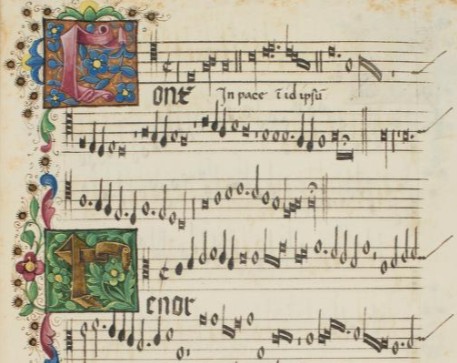
Page 1Complete MP3 RecordingQue vous madame/In pace in idipsum* (5 pages)
* There is little doubt that the original 3-part work is by Josquin,
but a si placet additional 4th part just might be by Agricola, and this is the version presented here.
This edition presents the work as a Motet-Chanson.
Page 1Complete MP3 Recordingbut a si placet additional 4th part just might be by Agricola, and this is the version presented here.
This edition presents the work as a Motet-Chanson.